
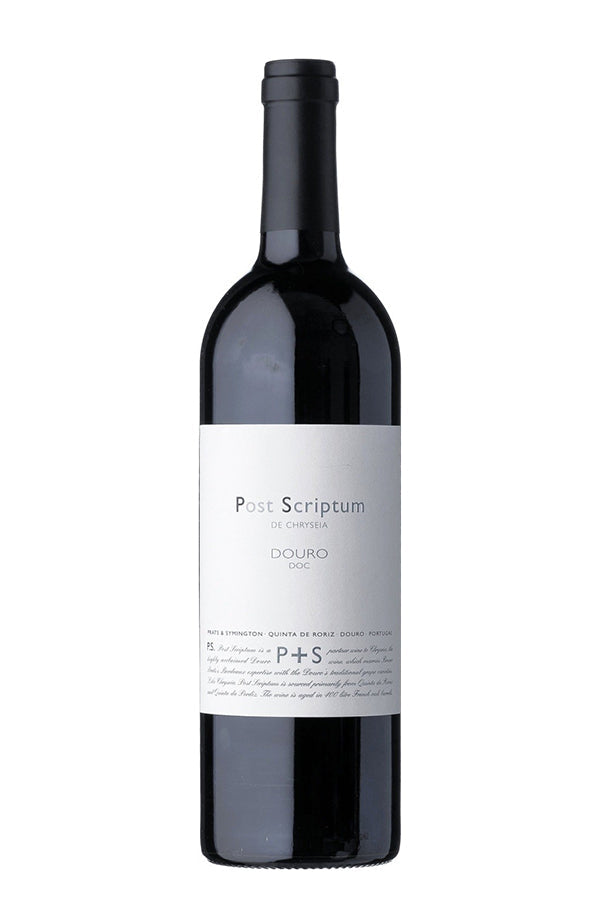

Prats & Symington Douro Post Scriptum De Chryseia
✔ $14.99 Nationwide Flat Rate Shipping
✔ Free Shipping on Orders $150+
✔ 3-4 Business Day Shipping
✔ Trusted by Cocktail Enthusiasts Nationwide
Bottle design may vary from image shown.
🔒 Guaranteed Safe & Secure Checkout
Description
Prats & Symington "Post Scriptum" de Chryseia Douro Red (750ML)
Prats & Symington "Post Scriptum" de Chryseia is a highly acclaimed, masterfully executed dry red wine that represents one of the most successful cultural and viticultural partnerships in modern wine history. Established in 1999, Prats & Symington is a joint venture uniting two global wine dynasties: Bruno Prats (the legendary former owner of Bordeaux’s famed Château Cos d’Estournel) and the Symington Family (the historic, multi-generational British-Portuguese pioneers who dominate premium Port production in the Douro Valley).
While the Douro Valley historically built its global empire on sweet, fortified Port wines, Prats & Symington was founded with a singular, revolutionary goal: to apply strict, old-world Bordeaux winemaking precision to the region's powerful indigenous grapes, proving the Douro floor could produce still, dry red wines of true world-class elegance.
Born explicitly as the "second wine" to their iconic flagship Chryseia (the absolute first Portuguese dry red ever to break into the Wine Spectator Top 10), Post Scriptum is pulled from the exact same hand-sorted, estate-grown plots at Quinta de Roriz and Quinta da Perdiz in the Cima Corgo. Because it is handled like a Bordeaux second growth, it shares the grand vin’s pedigree, concentration, and vertical structure but is deliberately crafted to be more approachable, juicy, and expressive in its youth.
Technical Wine Specs
-
Size: 750ML Standard Heavy Bordeaux-Style Format
-
ABV: ~14.0% to 14.5% (Vintage Dependent)
-
Wine Type: Full-Bodied, Rich, and Highly Refined Dry Red Wine
-
The Indigenous Blend: Typically spearheaded by Touriga Nacional and Touriga Franca, with smaller structural inclusions of Tinta Roriz (Tempranillo) and Tinta Barroca.
-
Winemaking Program: Grapes are entirely hand-harvested and undergo a rigorous automated optical berry-selection process. They are gently crushed and fermented at a controlled $25^\circ\text{C}$ ($77^\circ\text{F}$) with gentle macerations to favor vibrant fruit extraction over harsh, astringent tannins.
-
Aging Regimen: Matured for 12 months in 400-liter French oak barrels (utilizing second- and third-fill wood). The larger barrel size and neutral wood shield the native grapes from heavy vanilla tones, preserving primary mineral freshness.
-
Origin: Douro DOC, Cima Corgo, Portugal
-
Critical Pedigree: An absolute favorite among global critics, consistently capturing outstanding 91-Point to 93-Point sweeps from Wine Spectator, Robert Parker’s Wine Advocate, and James Suckling.
Tasting Notes: Flavor and Aroma Profile
The masterful assembly of Touriga Nacional and Touriga Franca grants the liquid a deeply concentrated, dark ruby-indigo color in the glass with high visual density.
-
Aroma (Nose): Strikingly fragrant, clean, and expressive. The bouquet opens with an upfront wave of ripe mulberries, wild blackberries, and baked plums, beautifully layered over secondary top notes of fresh lavender, crushed rockrose (esteva), Earl Grey tea, and a faint hint of white pepper.
-
Palate (Taste): Full-bodied yet beautifully precise, fresh, and light on its feet. The entry floods the mouth with a juicy arrival of black cherries and cassis sorbet. Across the mid-palate, it unrolls a gorgeous, velvety texture where the dark fruits meld seamlessly with savory dried herbs, cocoa powder, and dark balsamic olive notes.
-
Finish: Exceptionally focused and persistent. The intense dark fruits transition smoothly into a clean, bright, and mineral-driven finish highlighted by fine-grained, powdery tannins and a racy, mouthwatering natural acidity.
Service and Presentation Rituals
-
The Decanting Window: Because these indigenous Douro grapes naturally pack massive structural concentration, the wine responds beautifully to oxygen. Pour the bottle into a decanter for 30 to 45 minutes before serving. This brief aeration uncoils the tight tannins and coaxes out the fragile violet, lavender, and Earl Grey aromatics.
-
The Cellar Target: Avoid serving this premium red at a hot room temperature, which can make the 14% alcohol feel top-heavy and mask the herbal complexity. Aim for a perfect cellar chill of 60°F to 64°F (15°C to 18°C).
-
The Glassware: Serve inside a standard, wide-bowled Cabernet or Bordeaux glass to give the intense fruit oils room to expand.
High-End Food Pairings
Post Scriptum’s brilliant calibration of powdery tannins, dark berry density, and savory herbal acidity allows it to perform spectacularly alongside rustic, fat-heavy, and gamey culinary profiles.
-
Flame-Charred & Roasted Proteins: An absolute textbook pairing next to roast leg of lamb with garlic and rosemary, pan-seared venison, or a premium grilled ribeye steak. The wine's firm tannin matrix binds to and cleanly dissolves rich meat fats.
-
Rustic Mediterranean Braises: Pair a glass alongside slow-cooked beef stews, wild boar ragu tossed with pappardelle pasta, or roasted duck breast with a plum reduction, which naturally mirrors the wine's built-in blackberry notes.
-
Salty Artisanal Cheeses: It behaves beautifully next to a luxury board highlighting blocks of aged Manchego, mature white Cheddar, or traditional Portuguese Queijo da Serra, where the salty dairy oils melt into the wine's velvety finish.
Frequently Asked Questions (FAQs)
Is Post Scriptum sweet like a Port wine?
No, it is completely dry. While it is crafted from the exact same indigenous grape varieties (Touriga Nacional and Touriga Franca) and grown on the exact same steep Douro terraces used to make sweet, fortified Port wines, Post Scriptum is a table wine. The grape sugars are completely fermented out into alcohol, resulting in a savory, structured, and bone-dry red wine with zero syrupy or cloying sweetness.
What does "Post Scriptum" mean in relation to Chryseia?
In writing, a postscriptum (P.S.) is an afterthought or an elegant continuation of a letter. In winemaking, Bruno Prats and Charles Symington chose this name because the wine is literally the continuation of their flagship Chryseia. It is built using the exact same fruit from the exact same harvest blocks; the barrels that display an upfront, explosive fruit profile with softer tannins are separated into the "Post Scriptum" lots, while the barrels showcasing massive, tighter long-term aging longevity are reserved for the grand vin.
Can I cellar this bottle?
Yes. While the winemakers explicitly style Post Scriptum to possess an approachable, juicy, and velvety texture so that it is ready to pop and enjoy tonight, its intense grape concentration and pristine acidity give it a beautiful lifespan. If kept in a cool, dark environment, an unopened bottle will easily cellar and evolve gracefully for 7 to 10+ years.
SEO Optimization Matrix
-
Meta Title: Buy Prats & Symington Post Scriptum de Chryseia Douro Red
-
Meta Description: Experience the 92-point luxury of Post Scriptum de Chryseia by Prats & Symington. A refined, dry Portuguese red wine bursting with blackberry, violet, and velvety tannins. Shop now!